• Hoher Kontrast
  • Display Search
  • Login to ICSD
  • ICSD Depot
Home Home Home
  • About
  • ICSD Products
  • Application Examples
  • Support
  • Data Curation

Essential tools for developing new functional materials recommended by Rietveld Analysis Master

  • Gain unique advantage by acquiring skills with few experts
  • Realize reliability of ICSD from experience of being pointed out incorrect data
  • Continue to refine the analysis skills as customers’ last hope

Interview with Dr. Takanori Itoh
Technical Manager, Device Analysis Laboratory, Analysis PF Department, NISSAN ARC, LTD.

""

Dr. Takanori Itoh from NISSAN ARC, LTD., who is known for distinguished skills for material analysis by using Rietveld analysis and First-principles calculation, was interviewed about how to use ICSD.

Gain unique advantage by acquiring skills with few experts

JAICI: Could you tell us about your research?

Dr. Itoh: NISSAN ARC, LTD. is an analysis service company with a wealth of know-how accumulated in analysis of automotive materials. There are many requests for analysis related to lithium-ion batteries (LIBs) and fuel cells, and at the same time we are also conducting joint research with other companies, research institutes and so on to develop novel materials and new analysis methods also. For example, in 2016, we carried out a variety of advanced analyses to determine the structure of amorphous silicon and published it to Nature Communications1. Our company is an analysis service company conscious of constructing cutting-edge technology at any time. In particular, the advanced analysis technology for LIBs and fuel cells are highly evaluated at home and abroad.

1 Akihiko Hirata, Shinji Kohara, Toshihiro Asada, Masazumi Arao, Chihiro Yogi, Hideto Imai, Yongwen Tan, Takeshi Fujita & Mingwei Chen, "Atomic-scale disproportionation in amorphous silicon monoxide", Nature Communications 7, Article number: 11591 (2016). doi:10.1038/ncomms11591

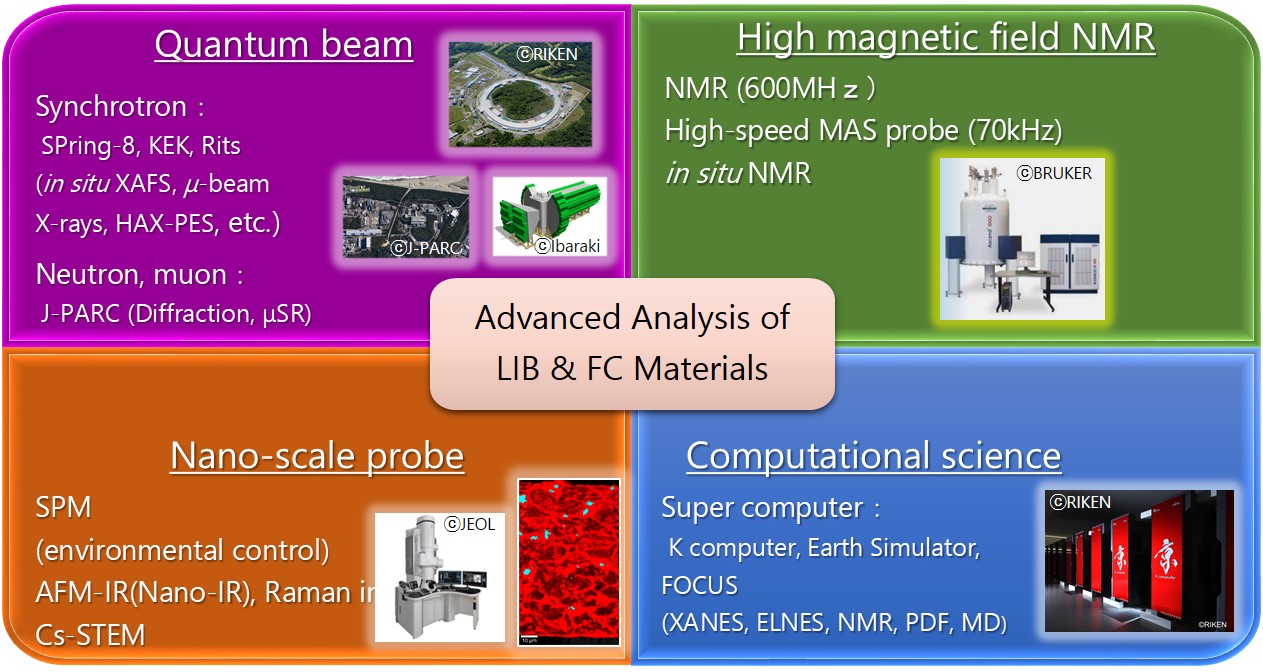
High-end solution using Advanced analysis technology

""

Figure 1: NISSAN ARC, LTD.'s advanced analytical technology is highly evaluated worldwide, which supports basic research, device development, process and production technology development, and quality management.

I was originally engaged in the research and development of LIBs for electric vehicles at Nissan Motor Co., Ltd., but I wanted to develop the materials by myself, so I changed my job to a material manufacturer, AGC Seimi Chemical CO., LTD. Then, I wanted to acquire skills that could become my strength, so I began to specialize in structure analysis about 10 years ago. I studied in the group of Prof. SASAKI Satoshi of Tokyo Institute of Technology and acquired skills such as Rietveld analysis and first-principles calculation, and now I'm applying the skills to the analysis of various materials. These structure analysis methods can be applied to obtain information on fatigue and strength of plastic materials as well as inorganic materials. I'd like to continue to challenge such unprecedented analysis ahead of others.

In addition to the structure analysis skills, my experience of developing materials at the material manufacturer has been giving an advantage on the current job. With the perspectives of both a developer and an analyst, not only can I present the numerical values of the obtained data, but also I can give feedback to customers such as about what is reducing the performances of the material.

JAICI: Why were you interested in Rietveld analysis?

Dr. Itoh: A major reason is that there were few experts who could perform Rietveld analysis. Of course, there were some professors in university mastering Rietveld analysis. Also, in the field of inorganic material analysis, X-ray diffraction measurement (XRD) is always performed, and a variety of information can be obtained from the powder diffraction patterns, but most of the people just look at the XRD patterns. Transmission electron microscope (TEM) and X-ray photoelectron spectroscopy (XPS) are superior to XRD when they are used for qualitative analysis or local observation of materials. However, they are no match for XRD on nanoscale and quantitative analysis. It is even possible to quantify the amorphous amount in a sample. However, few people are trying to extract a lot of information from XRD data, so I thought that mastering Rietveld analysis would be an advantage.

About five years ago, I wrote a book for Rietveld analysis beginners. I carefully explained the information necessary for them from the installation procedure of the Rietveld analysis software RIETAN-FP to the know-how on dealing with error messages. It seems that many people have read the book. Nevertheless, that not everyone can grasp it is the reason what this analysis is profound. After studying Rietveld analysis, I found myself unsatisfied with analysis at laboratory scale, so I have expanded experiments into synchrotrons and neutron diffraction experiments as structure analysis methods to discuss light elements such as lithium used in LIBs. Also, I wanted to know the information of each element, so I began to perform the X-ray Absorption Spectra (XAS). After that, I wanted to demonstrate how the structure analysis data such as bond length and bond angle affects the physical properties of materials, so I did first-principles calculation. Using the first-principles calculation, I came to understand various points particularly in the field of battery materials; for example, we can calculate the electronic structure to predict whether or not electricity may flow into the substance to be analyzed. I'm always searching for new analysis methods while thinking that customers will be pleased once they get to know those various points. If it is my own research, I can just present what I think, but I must do analysis and calculations for the customers’ satisfactions. This is quite difficult, but I think it's challenging and essential for my own growth in analysis skills.

""

Figure 2: It is possible to discuss crystal structure parameters and electron density by means of Rietveld analysis/Maximum Entropy Method of Synchrotron XRD data with ICSD's CIF as the initial structure.

Realize reliability of ICSD from experience of being pointed out incorrect data

JAICI: When did you start using ICSD?

Dr. Itoh: I got to know ICSD when I was studying structure analysis at Tokyo Institute of Technology, and I have been using it since then. It's really an essential tool for structure analysis. I always download CIF Files from ICSD as initial data necessary for Rietveld analysis. It's also an essential item to build the initial structure of first-principles calculation.

JAICI: Why are you using ICSD?

Dr. Itoh: ICSD is convenient because I can quickly get crystallographic data such as crystal structures and cell parameters of various compounds without reading papers one by one. Above all, we evaluate ICSD as providing highly reliable data. In fact, when I submitted a paper with crystal structures, I was asked to provide the original raw data by FIZ-K. When the data was verified by their staff, it was pointed out that there was an error in my analysis results. After I reviewed it, I found I made a mistake to refine zero-shift parameters and the cell parameters together, and I realized that largely deviating the zero point had affected the cell parameters. I came to know that the data contained in ICSD have been properly verified so far, and I felt the data highly reliable (*).

There are also other free downloadable open databases, but they cannot substitute for ICSD in terms of reliability. In fact, many free CIF files cannot be opened by software.

JAICI: What are you using ICSD specifically for?

Dr. Itoh: The ICSD data contains atomic coordinates, so it's important for precise structure analysis. If a CIF file downloaded from ICSD is read into VESTA, VESTA converts the CIF file into a file for RIETAN-FP so that I can move on to Rietveld analysis smoothly. The atomic coordinates which are necessary for first-principles calculation are also obtained from ICSD and are useful. ICSD is essential for those who are researching new materials in the industry of battery materials like us.

(*) ICSD data is verified by trained experts. When they find incorrectness or anomalous parameters in the data, they note in Warnings & Comments in ICSD record.

""

Figure 3: ICSD Record (The CIF Files can be easily exported with a single click. In addition, FIZ-K has provided Quality standards and gave a mark of High Quality Data to the records that meet the standards in the process of data verification. When a user can't decide which record to use among plural records, the mark can be used as an indicator of better record.)

Continue to refine the analysis skills as customers’ last hope

JAICI: Could you share your thoughts on the structure analysis?

Dr. Itoh: The structure analysis is irresistible to me. At academic meetings, little attention is paid to XRD-related presentations, since XRD analysis seem to be old technology. Some researchers are doing Rietveld analysis, but most of them seem to determine only cell parameters. Actually, it is better for them to discuss the atom occupancy factors, Debye-Waller factors and so on, but I think they can't afford it. In consideration of the circumstances, I'd like to respond any requests from any customers even if they are difficult tasks. Our customers trust my analysis skills and think me as their last hope since I'm one of the researchers who are using RIETAN-FP to do Rietveld analysis most in the world.

JAICI: Could you tell us about your future prospects?

Dr. Itoh: A recent challenge is mapping of structural parameters. We are promoting joint research with other organizations while thinking that it would be interesting to three-dimensionally visualize structural parameters, cell parameters, occupancy factors of certain atoms and so on from the data obtained by changing the conditions by using a synchrotron and so on, like imaging by scanning electron microscope (SEM), infrared spectroscopy (IR), Raman spectroscopy, and so on. But actually, I'm dreaming of being a philosopher in the future. What I want to study most is the Foucault’s structuralism. Of course, it’s completely different from the structures in our research.

JAICI: Thank you very much today.

NISSAN ARC, LTD.
1 Natsushima-cho, Yokosuka, Kanagawa, Japan
(Photo source: http://yokokenkyo.com/?page_id=85)

Established in 1990. NISSAN ARC, LTD. is an analysis services company with a unique starting point from an automotive company. Providing novel one-stop total analytical solutions integrating from state-of-the-art analytical techniques such as quantum beams and computational analytics to prototyping and evaluation to create added-value for customers’ products and services.

Website http://www.nissan-arc.co.jp/

""

Dr. Takanori Itoh

1992 Graduated from Department of Industrial Chemistry, Faculty of Engineering, Tokyo University of Science. 1998 Completed Doctoral Program in Department of Industrial Chemistry, Graduate School of Engineering, Tokyo University of Science. Doctor (Engineering). 1998 Research Fellow, JST Strategic Basic Research programs, Japan Science and Technology Agency. 1999 Joined Nissan Motor Co., Ltd. to engage in research and development of lithium-ion batteries. 2005 Joined AGC Seimi Chemical Co., Ltd. to engage in development of solid oxide fuel cell materials and analysis of crystal structures. Also Visiting Research Fellow of Idemoto-Kitamura Group, Department of Industrial Chemistry, Faculty of Engineering, Tokyo University of Science (~2016). 2016 Joined NISSAN ARC, LTD.

Manager of Device Analysis Laboratory, Device Analysis Department. 2017 Lecturer of Rikkyo University, also Organizer of the Ceramic Society of Japan. He has written books such as "Rietveld analysis using RIETAN-FP" (JOHOKIKO CO., Ltd., July 2012).

Interview with Dr. Itoh

Interview-with-Dr-Itoh.pdf
  • Accessibility declaration
  • Privacy Policy
  • Legal Notices
©2025 FIZ Karlsruhe GmbH
FIZ Karlsruhe Logo